.png) October 6, 2026
October 6, 2026
.png) In-Gas Team
In-Gas Team
.png)
Hydrogen Flammability: 5 Safety Hazards That Go Beyond Fire
Everyone working around hydrogen knows it is flammable. The problem is that this familiar warning can overshadow the less obvious hazards that cause incidents in laboratories and manufacturing plants.
Hydrogen can escape through exceptionally small openings, collect near ceilings, ignite with very little energy, and burn with a flame that is difficult to see. It can also weaken certain metals over time. Managing hydrogen flammability therefore requires more than removing obvious ignition sources. It calls for compatible equipment, correctly positioned detectors, effective ventilation, controlled purging, and storage practices designed specifically for hydrogen.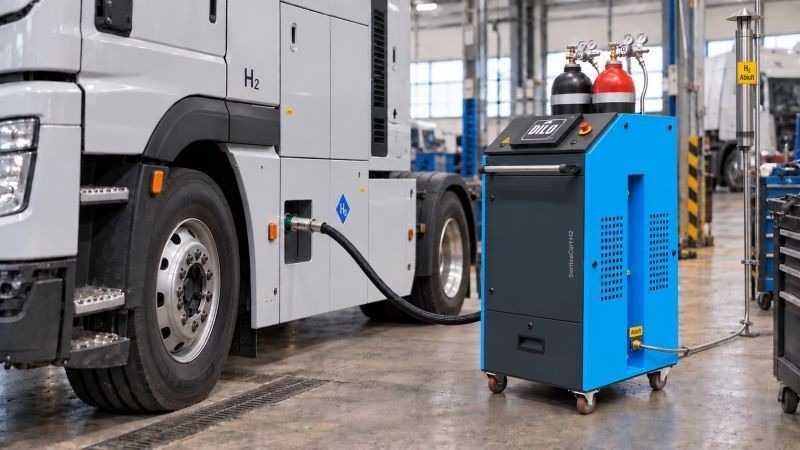
Understanding Hydrogen Flammability: More Than a Warning Label
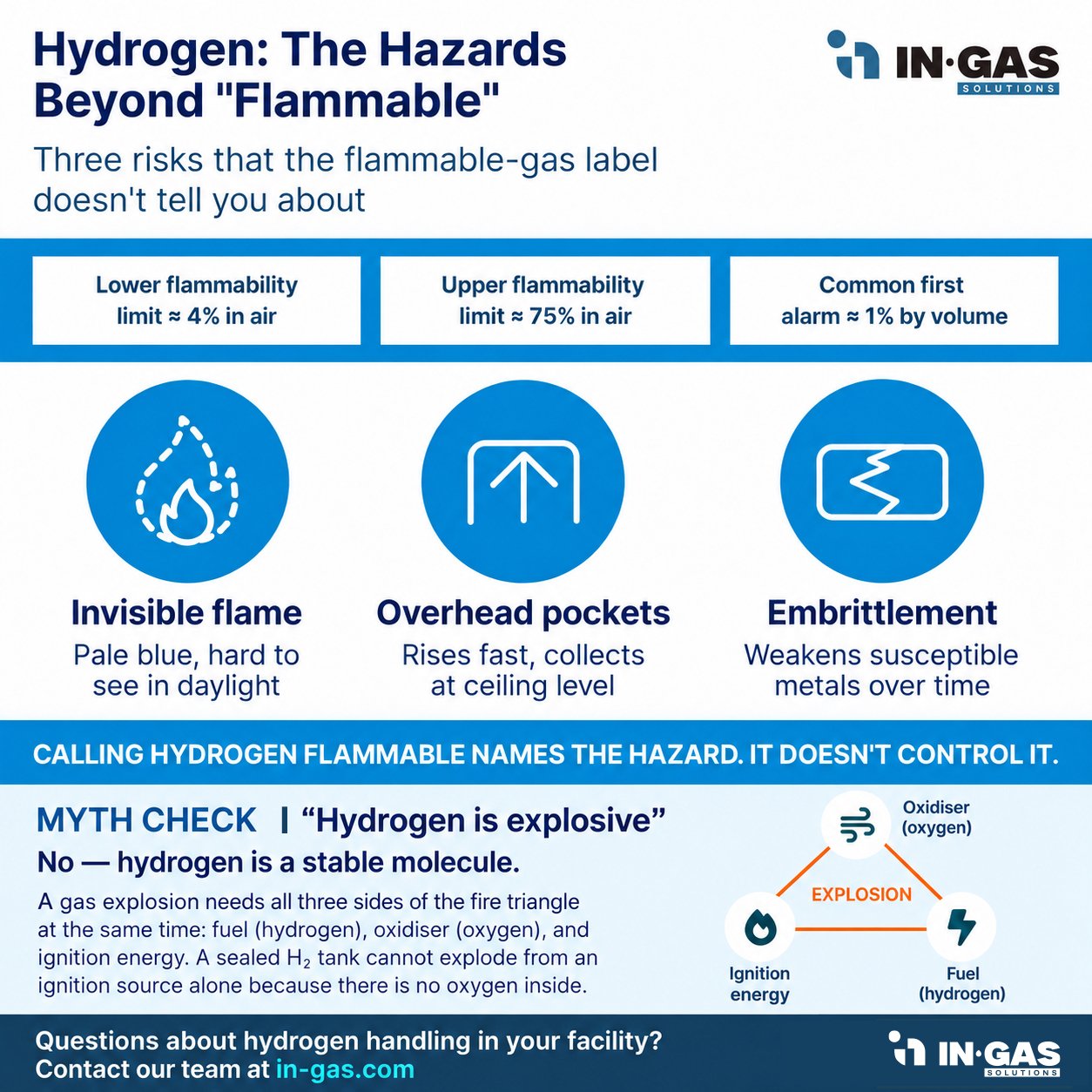
What does hydrogen flammability mean in practical terms? According to H2Tools, hydrogen's flammability range in air extends from about 4% to 75% by volume. The lower flammability limit, or LFL, is the lowest concentration that can support combustion, while the upper flammability limit, or UFL, is the highest.
That unusually broad hydrogen flammability range in air creates more opportunities for a leaked gas cloud to become ignitable. Near its most easily ignited mixture, hydrogen has a minimum ignition energy of roughly 0.02 mJ—more than ten times lower than methane or propane. A small electrical spark, static discharge or hot surface may therefore be sufficient to ignite it.
A flammability diagram helps engineers visualize how hydrogen, oxygen, and an inert gas interact. Mixtures inside the flammable region can burn if an adequate ignition source is present. Purging changes the mixture composition so that equipment can transition between air and hydrogen service without passing uncontrolled through that region.
Temperature, pressure, and the presence of oxygen or inert gases can widen or narrow the flammable range. For this reason, the commonly cited 4% and 75% hydrogen flammability limits should be treated as foundational safety information, not as substitutes for a process-specific hazard assessment.
Hydrogen's Invisible - Flame Problem
A hydrogen fire may not look or feel like a conventional fuel fire. Its flame can be pale blue and nearly invisible in daylight, while producing considerably less radiant heat than a hydrocarbon flame. Personnel may therefore receive little visual or thermal warning until they are dangerously close to the fire.
Someone approaching what appears to be a simple equipment leak could unknowingly walk into or reach through a flame. Heat shimmer, unusual sounds or damage to nearby materials may provide clues, but none is an acceptable primary detection method.
Historically, responders sometimes used a combustible object such as a broom to probe for an invisible flame. That practice introduces personnel and additional fuel into a potentially dangerous area. Modern facilities should instead use suitable ultraviolet, infrared, or combined flame-detection technology and follow an established emergency response procedure.
Personnel should never attempt to locate a suspected hydrogen flame by touch or by approaching the release point.
Hydrogen Rises and Collects Where Detectors Aren’t
Hydrogen is the lightest gas. When released indoors, it rises rapidly and can collect around ceilings, roof structures, enclosed canopies and the upper sections of equipment cabinets.
That behavior is easy to misunderstand. A room may appear open and well ventilated at working height while still containing an ignitable pocket above ducts, beams or suspended fixtures. A conventional low-level detector may never encounter the gas.
Ventilation should remove hydrogen from the highest likely accumulation points and discharge it to a safe location. Designers should examine the room's actual geometry rather than relying only on a general air-change rate. Ceiling recesses, enclosed cabinets, and other dead zones may require dedicated extraction or detection.
Hydrogen can also displace oxygen in a confined area. Although hydrogen is not toxic, a substantial release can still create an oxygen-deficient atmosphere.
Hydrogen Embrittlement Can Turn Materials Into a Hidden Weak Point
Hydrogen atoms can enter susceptible metals and reduce their ductility or resistance to cracking. This phenomenon, known as hydrogen embrittlement, may affect piping, welds, valves, regulators, and other pressurized components. Embrittlement can lead to cracking or leaks without obvious visible warning.
The risk depends on the material, strength, stress, temperature, pressure, manufacturing history, and service conditions. High-strength steels can be particularly vulnerable, but compatibility should never be assumed from a general material name alone.
The U.S. Department of Energy identifies steel and weld embrittlement, permeation, and leakage as technical concerns for hydrogen pipelines. Austenitic stainless steels and certain engineered alloys are often used in hydrogen systems. However, engineers still need to select material grades, seals, and joining methods for the actual pressure and duty cycle.
Existing compressed-gas hardware should not automatically be repurposed for hydrogen. A sound inspection program looks for more than visible corrosion. It should consider leak history, fatigue, cracking, damaged connections, and manufacturer-recommended component replacement intervals.
Choosing the Right Hydrogen Leak Detection System
Hydrogen is colorless, odorless, and tasteless. Unlike natural gas supplied for domestic use, it provides no built-in sensory warning of a leak. Detection must come from instrumentation.
Fixed detectors provide continuous coverage around likely release and accumulation points. Portable instruments support commissioning, maintenance, and leak investigations. Depending on the application, detection technologies may include catalytic, electrochemical, thermal-conductivity, or other hydrogen-specific sensors.
Selection should account for the expected concentration range, response time, operating temperature, interfering gases, and oxygen conditions. A sensor that performs well in one process may be inappropriate in another.
Placement is just as important as sensor type. Detectors are generally positioned at high points and near credible leak sources, while avoiding locations where airflow could dilute the gas before it reaches the sensor.
Alarm setpoints should provide warning well below the LFL. A common first-alarm reference is 1% hydrogen by volume (25% of the 4% LFL), but final settings should follow the applicable code, risk assessment, and facility response plan. Suitable hydrogen gas measurement supports continuous monitoring of gas quality, moisture, and process conditions.
Purging and Venting Without Creating a Flammable Mixture
Opening a hydrogen system directly to air can create a flammable mixture inside the equipment. The same risk exists when hydrogen is introduced into air-filled piping.
An inert gas such as nitrogen or argon is commonly used to separate the hydrogen and air from mixing. Before startup, the system is purged to remove air before hydrogen enters. Before maintenance, hydrogen is displaced with inert gas, and the system is verified safe according to the approved procedure.
A purge procedure should define:
- The correct purge gas and flow direction
- The required volume exchanges or verification criteria
- Suitable sampling and measurement points
- Valve sequencing and isolation steps
- Conditions required before introducing hydrogen or opening equipment
Vent lines should terminate outdoors in a safe location, away from air intakes, occupied areas, and ignition sources. Their routing should avoid restrictions and pockets where gas or moisture could accumulate. Purpose-designed hydrogen equipment can support controlled handling, measurement, storage, purging and depressurization.
Hydrogen Storage Safety Requires Segregation
Keep hydrogen away from oxygen and other oxidizers because a release involving both fuel and oxidizer creates a much more severe fire and explosion scenario.
Secure cylinders upright, protect them from physical damage and heat, and manage valves and protective caps according to supplier instructions. Empty cylinders still require controlled handling because residual gas may remain inside them.
The exact separation requirement depends on the facility, application, and governing code. For storage covered by OSHA’s welding and cutting standard, its rules for oxygen and fuel-gas cylinder separation specify at least 20 feet of separation or an approved noncombustible barrier meeting stated height and fire-resistance requirements.
Liquid hydrogen adds another layer of risk. Along with flammability, facilities must manage extremely low temperatures, cold burns, material compatibility, pressure buildup from boil-off, and rapid gas expansion. Cryogenic hydrogen systems therefore require controls beyond those used for ordinary compressed-gas cylinders.
Building Hydrogen Safety Guidelines Into Daily Work
Hydrogen is not automatically more dangerous than every other flammable gas. Hydrogen gas hazards are different, and problems arise when a facility manages it as though it behaves like propane, methane, or a routine inert process gas.
An effective safety program should include:
- A documented process hazard assessment
- Hydrogen-compatible piping, seals and components
- High-point ventilation and appropriately placed detectors
- Written purging, startup and shutdown procedures
- Cylinder segregation and inventory controls
- Detector calibration and functional testing
- Training for normal operations, maintenance and emergencies
- Inspection and replacement criteria for pressure-containing components
- Clear records of alarms, leaks, repairs, and system modifications
Emergency planning should also account for an invisible flame. Personnel need to know how alarms are communicated, when to evacuate, and who can isolate the gas supply or investigate a suspected release.
Hydrogen Safety Starts Where the Flammable-Gas Label Ends
Calling hydrogen “flammable” identifies the hazard, but it does not explain how to control it. Safe use in laboratories and manufacturing facilities also depends on detecting overhead leaks, recognizing nearly invisible flames, selecting compatible materials, managing purge transitions, and keeping fuel separated from oxidizers.
These risks are manageable when you design the right controls into the system from the start. If you need help selecting safe, application-specific handling, measurement, purging, or storage equipment, contact In-Gas Solutions to discuss your hydrogen process requirements.

In-Gas Team
About the In-Gas Team: The In-Gas blog is authored by a collaborative team of industry experts, technicians, and content partners. Our contributors bring hands-on experience from the field, deep knowledge of SF₆ and alternative gas management, and insight into evolving compliance and sustainability standards. Whether written by our service technicians, training specialists, or SEO/content partners like Hirudo, every post reflects our shared commitment to environmental stewardship, utility reliability, and zero-emission gas handling.