.png) May 14, 2026
May 14, 2026
.png) In-Gas Team
In-Gas Team
.png)
The 2026 helium shortage is not a balloon problem. It’s a precision manufacturing problem, and for many facilities, it’s already a cost problem.
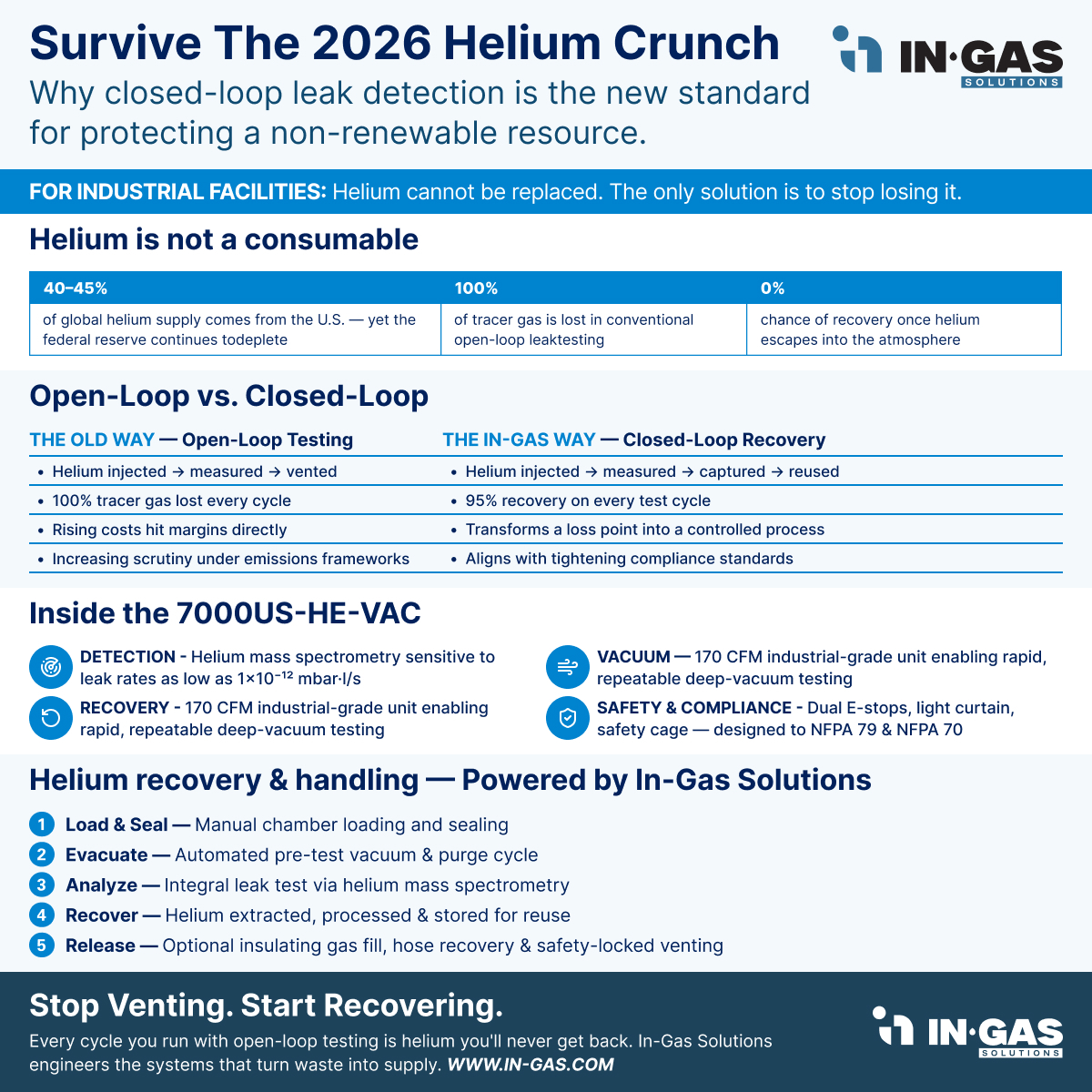
Helium is classified by the U.S. Geological Survey as a critical mineral. It cannot be manufactured, synthesized, or economically recovered once released into the atmosphere. When helium escapes, it’s gone permanently. That reality alone changes how facilities should think about helium, not as a consumable, but as a finite operational resource.
According to the USGS Mineral Commodity Summaries 2026, the United States still supplies roughly 40–45% of global helium production, yet the federal helium reserve continues to be depleted. At the same time, demand spans multiple high-dependency sectors, including MRI manufacturing, semiconductor fabrication, aerospace systems, fiber optics, and precision leak testing.
This is not a localized supply issue. It’s a structural constraint. And every cubic meter lost during testing or handling is a cost that cannot be recovered.
Facilities that treat helium as expendable are now facing a simple reality: the old way of testing is no longer sustainable.
Why Helium Waste Is an Invisible Cost Most Facilities Don’t Measure
In many industrial environments, helium loss is not tracked with the same rigor as energy or material waste. It happens quietly, cycle by cycle, inside leak detection processes that were never designed to recover tracer gas.
In a conventional open-loop helium leak detection setup, the process is straightforward: helium is injected into the test object, the leak rate measurement is performed, and the gas is vented to the atmosphere. That means 100% of the tracer gas is lost every cycle.
At lower helium prices, this inefficiency was tolerated. In today’s market, it comes at a measurable cost.
If your operation runs continuous leak testing, whether for switchgear, sealed systems, or high-integrity components, you are effectively paying for helium that you use once and discard immediately. Multiply that across daily production cycles, and the cost becomes a material impact on your margins.
There is also a growing regulatory dimension. Emission standards are tightening across industrial sectors, and while helium is inert, venting gas at scale is increasingly scrutinized within broader emissions compliance frameworks.
This is where the shift toward closed-loop helium gas handling becomes critical.
Instead of treating helium as expendable, facilities are now adopting systems that capture and reuse it. A properly engineered helium recovery system transforms leak testing from a loss point into a controlled process, reducing both cost and environmental exposure.
How In-Gas Solutions Engineered the Answer
To address both the economic and technical challenges of helium loss, In-Gas Solutions developed a fully integrated, automated leak detection and recovery platform. This is not a retrofit or add-on system. It is a purpose-built, high-vacuum test station designed from the ground up for precision leak detection and closed-loop helium management.
At its core is a high-sensitivity helium mass spectrometry unit capable of detecting leak rates as low as 1×10⁻¹² mbar·l/s. In practical terms, this means the system can identify leaks so small they are effectively invisible to conventional testing methods, ensuring product integrity in industries where failure is not an option.
The chamber is supported by a 170 CFM industrial-grade vacuum unit, enabling rapid evacuation and stable deep-vacuum conditions. This is critical for repeatable testing, particularly in high-throughput environments where cycle consistency matters.
Where the system differentiates itself is in recovery. The integrated filling and recovery architecture is engineered to reclaim more than 95% of the helium used during each test cycle. Instead of venting gas to the atmosphere, the system captures and reconditions it for reuse, dramatically reducing ongoing consumption.
Operation is controlled through an industrial HMI interface with automated PLC sequencing. From the operator’s perspective, the process is simple: load the test unit, initiate the cycle, and allow the system to execute. The complexity is handled internally, with consistent, repeatable outcomes.
This is the class of systems that defines modern helium leak detection systems, precision-driven, automated, and built around conservation.
Optimized Throughput with Zero-Waste Recovery
The credibility of any industrial system comes down to how it performs in real operation.
In-Gas Solutions has engineered a structured, efficient testing cycle that prioritizes both high-sensitivity accuracy and maximum gas recovery.
The process is divided into distinct, automated phases designed to eliminate the variables typically found in manual testing:
- Atmospheric Stabilization: The cycle begins with an automated pre-test phase where the chamber is evacuated and purged, establishing the precise vacuum conditions required for high-sensitivity measurement.
- Precision Analysis: During the integral leak test phase, the system utilizes helium mass spectrometry to identify even the smallest leaks with absolute confidence.
- Closed-Loop Recovery: Once testing is complete, the system transitions into an active recovery sequence. Rather than venting the tracer gas, the helium is extracted, processed, and stored for reuse. This step alone eliminates the largest source of waste in conventional testing and aligns with our commitment to sustainable gas handling.
- Integrated Gas Management: The cycle concludes with a precision backfilling sequence using a customer-specified gas, ensuring the test object is pressurized to exact requirements. This is followed by an automated hose recovery process to capture any remaining trace amounts before the chamber is vented.
- Operator Safety: A hardware safety interlock ensures the chamber cannot be opened until atmospheric equilibrium is verified, protecting both the operator and the system integrity.
The result is a comprehensive testing environment where nothing is lost unnecessarily—a fundamental shift from conventional, "vent-to-atmosphere" methods.
Enterprise-Grade Safety — Built Into Every Layer
For facilities operating under strict safety and compliance standards, system design must go beyond performance. It must account for operator protection, process integrity, and fail-safe behavior under all conditions.
Our high-vacuum platforms incorporate multiple layers of safety hardware to protect both personnel and the environment:
- Active Monitoring: Light curtains monitor the loading area during operation, preventing access during active cycles.
- Emergency Controls: Dual emergency stop systems provide immediate shutdown capability.
- Physical Isolation: A structural safety cage isolates high-pressure recovery components.
- Status Communication: Visual and audible indicators, including a multi-segment light tower and high-decibel alert system, provide clear status communication during operation.
From a technical standpoint, these systems are designed to meet the most rigorous industrial electrical and mechanical standards. Data logging capabilities, including CSV export, support traceability and audit requirements, while multi-level access control ensures that system operations are appropriately restricted.
This level of integration is not optional in modern facilities; it is expected.
Engineering the Future of Gas Management: A Case Study in Scale
For procurement and operations teams, the value of a high-vacuum platform is defined by what it represents as a long-term capital investment. At In-Gas Solutions, we specialize in delivering enterprise-scale helium testing systems that are proudly designed, engineered, and fabricated in the USA.
A typical system of this magnitude is structured across three primary modules:
- Core Infrastructure: A custom-engineered vacuum vessel and structural platform.
- Advanced Recovery: Integrated gas detection and closed-loop recovery systems.
- System Validation: Comprehensive performance verification conducted at our facility, prior to deployment.
This is not a commodity purchase. It is a strategic investment in process control, cost reduction, and compliance readiness. For facilities facing rising helium costs or increasing pressure on emissions, the financial case becomes clear over time. Recovering more than 95% of helium usage does more than just offset supply risk; it fundamentally changes the operating economics of the facility.
If your facility is currently venting helium as part of standard testing, the question is not whether there is waste—it is how much.
Don’t Be a Gashole™
The helium crunch is forcing a shift in how the industry approaches gas usage. What was once treated as a consumable is now recognized as a constrained resource with long-term implications for cost and availability.
Facilities have a choice.
Continue operating with open-loop systems that vent a critical, non-renewable resource into the atmosphere. Or adopt engineered solutions that treat helium as an asset, captured, reused, and controlled.
At In-Gas Solutions, the mission is simple: Don’t be a Gashole™. Precision you can trust. Recovery you can bank on.
Start the Conversation
If your operation is facing rising helium costs, tightening compliance requirements, or increasing pressure to improve efficiency, it’s time to take a closer look at how your system handles gas—from start to finish.
Connect with our team to evaluate your current process and identify opportunities to reduce loss, improve control, and protect your supply.
Because in a market where helium cannot be replaced, the only real solution is to stop losing it.

In-Gas Team
About the In-Gas Team: The In-Gas blog is authored by a collaborative team of industry experts, technicians, and content partners. Our contributors bring hands-on experience from the field, deep knowledge of SF₆ and alternative gas management, and insight into evolving compliance and sustainability standards. Whether written by our service technicians, training specialists, or SEO/content partners like Hirudo, every post reflects our shared commitment to environmental stewardship, utility reliability, and zero-emission gas handling.